
CNC Bridge Saw Price: What Affects the Cost in 2026
TL;DR:A Cnc Bridge Saw's price is set by seven independent levers — axis count, bridge span, spindle power, control system, accessories, brand/origin, and landed cost — not by a single model number.Entry 3-axis units land around $35,000–$48,000, mid 4-axis around $52,000–$72,000, and fully optioned 5-axis machines $75,000–$110,000 (all illustrative). The cheapest quote is rarely the cheapest machine, because freight, installation, and a closed control system quietly add cost after the invoice. Use the hand-calc framework below to turn a vague price into a line-item budget you can defend.
Quick Answer
A CNC bridge saw in 2026 typically costs between $35,000 and $110,000 landed, and the spread exists because you are not buying one product but a stack of configurable choices. The single largest lever is axis count: moving from a 3-axis to a 5-axis head commonly adds 30–50% to the base unit because tilt and rotation hardware, plus the controller logic that drives them, cost real money to build and calibrate. The second lever is bridge span — a 3.5×2.0 m table that handles full jumbo slabs needs a stiffer frame and longer rails than a 3.2×1.6 m table, and that steel shows up in the price. Spindle power, the control architecture (proprietary versus PC-based), and add-ons such as an automatic tool changer or a rotating table each layer on thousands more. Finally, the number on the machine is not the number you pay: ocean freight for a 3–5 tonne machine, crating, installation, and training routinely add $8,000–$15,000 on top. Price therefore tells you almost nothing until you see the configuration line by line.
The Seven Levers That Move the Price
Think of the quote as seven separate decisions. Each one has a price tag, and skipping the detail is how buyers get surprised at customs.
1. Axis count (3 / 4 / 5)
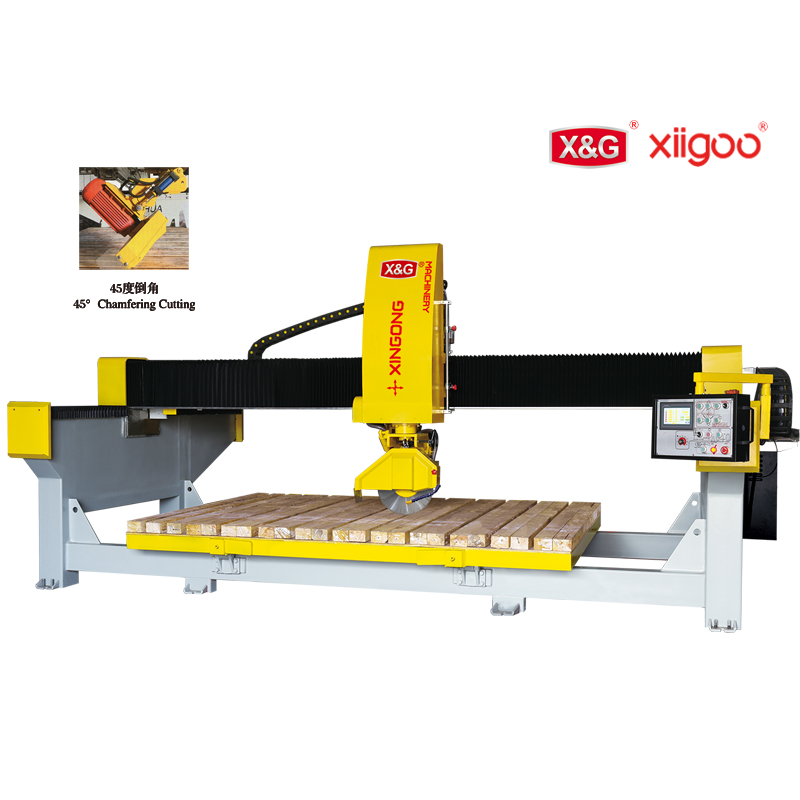
This is the biggest single jump. A 3-axis head cuts flat profiles only; a 4-axis head adds rotation for automatic 45° miters; a 5-axis head adds tilt for compound and 3D profiles in one setup. Because each added axis requires extra servo hardware, calibration, and controller programming, the step from 3-axis to 5-axis typically adds 30–50% to the base unit — illustratively $12,000–$22,000 on a mid-range machine. Buy only the axes your job mix actually uses.
2. Bridge span and table size
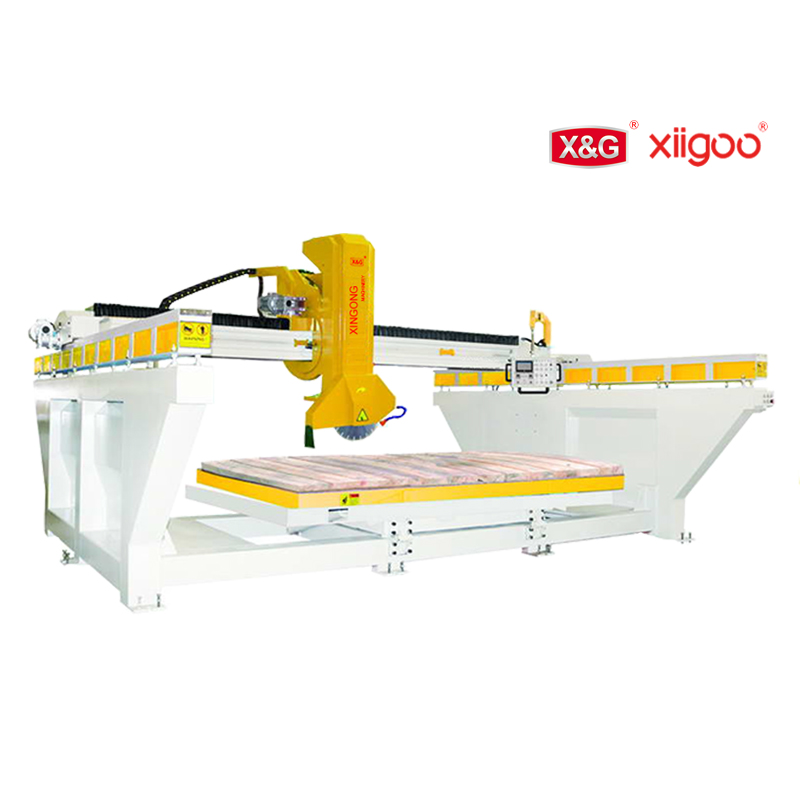
A table rated for 3.2×1.6 m slabs is cheaper than one for 3.5×2.0 m jumbo slabs, because the longer span needs heavier rails, a larger gantry, and stiffer welds to hold ±0.1 mm accuracy across the full width. Upgrading span by roughly 0.3 m commonly adds $3,000–$5,000 (illustrative), and matters most if you cut quartz or granite jumbo sheets that weigh up to 518 kg for a 3 cm slab at 2,700 kg/m³ density.
3. Spindle power
An 11 kW spindle suits standard granite and marble edging; 15–22 kW spindles sustain deeper cuts in hard stone and run larger blades without bogging.Each 4–7 kW step up adds roughly $2,000–$3,500 (illustrative), and pays off only if you cut dense material or run long uninterrupted batches where downtime costs more than the upgrade.
4. Control system
Proprietary embedded controllers are cheap and locked; PC-based controllers running standard CAD/CAM import cost more but let you reuse existing toolpaths and integrate with your shop software. A PC-based control commonly adds $3,500–$5,500 (illustrative) — often the best value lever, because it protects you from vendor lock-in over a 10-year machine life.
5. Accessories and automation
Add-ons compound fast: a rotating table (~$3,000), a probing/measuring head (~$1,200), an automatic tool changer (~$2,500), and vacuum clamping all stack. These options can add $5,000–$10,000 before you notice (illustrative). They are worth it only when they remove a manual step — a 518 kg granite slab is slow and hazardous to flip by hand (Natural Stone Institute density basis), so automation that removes the flip earns its price.
6. Brand and origin
A machine built and supported in your region carries a premium for local service and spare parts; imported units are leaner on price but longer on lead time and support distance. Expect a 10–25% band between equivalent imported and locally supported builds (illustrative). Weight this against how fast you need a service engineer on site when a spindle fails.
7. Landed cost (freight, install, training)
The ex-works price is a starting point, not the bill. Ocean freight plus crating for a 3–5 tonne machine commonly runs $3,000–$6,000 to a U.S. port, inland trucking adds more, and on-site installation with alignment and training typically costs $2,000–$5,000. Ignoring landed cost is the most common way buyers under-budget by $8,000–$15,000 (illustrative).
A Hand-Calc Landed-Cost Framework
Manual formula: Landed Price = Base Unit + Axis Premium + Span Upgrade + Spindle Upgrade + Control Premium + Accessory Sum + Freight + Installation + Training.
Worked example: Base 3-axis unit $32,000; axis premium to 5-axis +$14,000; span upgrade 3.2×2.0 m → 3.5×2.0 m +$3,500; spindle 15 kW → 22 kW +$2,800; PC-based control +$4,200; accessories (rotating table $3,000 + probe $1,200 + tool changer $2,500 = $6,700); sea freight + crating $3,800; installation + training $2,500. Total landed = $69,500.
Three Price Tiers, Side by Side
| Tier | Axis | Span | Spindle | Control | Illustrative landed price |
|---|---|---|---|---|---|
| Entry | 3-axis | 3.2×1.6 m | 11 kW | Proprietary | $35,000–$48,000 |
| Mid | 4-axis | 3.2×2.0 m | 15 kW | PC-based | $52,000–$72,000 |
| High | 5-axis | 3.5×2.0 m | 22 kW | PC + ATC | $75,000–$110,000 |
Five Questions That Set Your Tier
- Do you cut compound angles, 3D profiles, or sink cut-outs, or only straight and 45° work?
- Must you handle full jumbo slabs (3.5×2.0 m), or only standard 3.2×1.6 m sheets?
- Is daily throughput high enough that a second operator per machine would cost more than automation?
- Do you need automatic tool changes or probing to hit repeatable tolerances without manual setup?
- Is this a one-machine shop, or the first of several nodes in a growing line?
FAQ
What is the average CNC bridge saw price in 2026?
Illustratively, landed prices in 2026 run from about $35,000 for an entry 3-axis unit to $110,000 for a fully optioned 5-axis machine.
Why does the same "5-axis" quote vary so much?
Because options inside the "5-axis" label differ: bridge span, spindle power, control architecture, and automated tool changers each add thousands.
Is a used CNC bridge saw cheaper overall?
Sometimes, but verify spindle hours, controller software support, and that safety guards still meet current standards.
Does freight really move the price?
Yes. Sea freight plus crating for a 3 to 5 tonne machine commonly adds $3,000 to $6,000 to a U.S. port.
How much do installation and training add?
Typically $2,000 to $5,000 combined for on-site installation, alignment, and operator training.